Support our educational content for free when you purchase through links on our site. Learn more
12 NSF 401 Water Filter Brands to Check 🧪

Water filter brands with NSF 401 certification for emerging contaminants include AquaTru, Aquasana, Brita, Clearly Filtered, Culligan, Hydroviv, LifeStraw, Multipure, PUR, Samsung, Waterdrop, and ZeroWater—but certification applies to specific models and claims, not every product a brand sells. Before you buy, verify the exact filter and cartridge in a certifier’s directory, then check which contaminants are actually listed.
That model-by-model detail matters. Our testers have seen shoppers reach for a familiar brand name, only to discover that its popular pitcher cartridge and its higher-performance replacement don’t make the same claims. The certification record—not the logo, the brand name, or a sweeping “removes contaminants” headline—is the deciding evidence.
NSF/ANSI 401 covers reduction claims for a defined group of incidental and emerging compounds; it doesn’t mean a filter removes every pharmaceutical, PFAS compound, or other contaminant. If lead or chlorine is your concern, check for those separate claims too.
Key Takeaways
- Check the exact model and cartridge in a recognized certification directory; brand-level claims aren’t enough.
- NSF/ANSI 401 covers specific listed reduction claims, not every emerging contaminant. It doesn’t automatically certify PFAS, lead, or chlorine reduction.
- Match the filter to your water concern. Review your water-quality report or test private-well water, then verify the filter’s relevant claims.
- Keep up with cartridge changes. Certified performance depends on using the correct replacement and following the manufacturer’s instructions.
- Explore the brands: AquaTru | Aquasana | Brita | Clearly Filtered | Culligan | Hydroviv | LifeStraw | Multipure | PUR | Samsung | Waterdrop | ZeroWater
Table of Contents
- ⚡️ Quick Tips and Facts
- 🧪 What NSF/ANSI 401 Certification Means for Emerging Contaminants
- Which Contaminants Does NSF/ANSI 401 Address?
- What the Standard Does—and Doesn’t—Promise
- 📚 Water Filter Certification: Background and How NSF/ANSI 401 Evolved
- 🏷️ Water Filter Brands with NSF/ANSI 401-Certified Models
- 1. AquaTru
- 2. Aquasana
- 3. Brita
- 4. Clearly Filtered
- 5. Culligan
- 6. Hydroviv
- 7. LifeStraw
- 8. Multipure
- 9. PUR
- 10. Samsung
- 11. Waterdrop
- 12. ZeroWater
- 📊 Compare Filter Types, Certified Claims, and Replacement Needs
- Pitcher and Dispenser Filters
- Under-Sink and Countertop Filters
- Reverse Osmosis Systems
- Refrigerator and Whole-House Filters
- 🔍 How to Verify NSF/ANSI 401 Certification for a Specific Model
- Check the Exact Model Number and Certified Reduction Claims
- Search NSF, IAPMO, and Other Certification Directories
- Spot Misleading “Tested To” and “Mets Standards” Wording
- 🛒 How to Choose a Water Filter for Emerging Contaminants
- Match Certified Contaminant Reductions to Your Water Report
- Consider Filter Capacity, Flow Rate, and Maintenance
- Check Installation, Space, and Water Pressure Requirements
- Compare Filter Costs Without Cutting Corners
- 🚰 NSF/ANSI 401 vs. NSF/ANSI 42, 53, 58, and 473
- 🧼 Filter Installation, Cartridge Replacement, and Ongoing Care
- 🏠 Do You Need a Water Filter? Testing Tap Water and Reading Your Water Quality Report
- ⚠️ Common NSF 401 Certification Mistakes to Avoid
- ✅ Quick Tips for Buying an NSF/ANSI 401 Water Filter
- 🏁 Conclusion
- 🔗 Recommended Links
- ❓ FAQ
- Does NSF/ANSI 401 certification mean a filter removes every emerging contaminant?
- Are all filters from a certified brand NSF/ANSI 401 certified?
- Does NSF/ANSI 401 cover PFAS, lead, or microplastics?
- How can I tell whether a water filter’s certification is current?
- How often should I replace an NSF/ANSI 401 filter cartridge?
- Is NSF/ANSI 401 certification better than NSF/ANSI 53?
- 📖 Reference Links
⚡️ Quick Tips and Facts
- NSF/ANSI 401 is a specific reduction standard, not a blanket guarantee that a filter makes any water “safe.” Certification applies to a particular product and particular contaminant-reduction claims. Check the exact model in a certifier’s directory before buying. NSF’s product listings are a good place to start.
- Brand name alone isn’t enough. A brand may sell certified and uncertified models—or use different cartridges with different claims. Verify the filter and replacement cartridge combination.
- “Emerging contaminants” is a broad label. NSF/ANSI 401 addresses a defined set of substances that can occur at low levels in drinking water, including certain pharmaceuticals and chemicals. It does not mean a filter reduces every pharmaceutical, pesticide, PFAS compound, or microplastic.
- Certification isn’t the whole shopping list. If your concern is lead, look for a separate lead-reduction claim, commonly under NSF/ANSI 53; chlorine taste and odor are commonly addressed under NSF/ANSI 42. Verify each claim for your model.
- Replace cartridges on schedule. A filter’s certified performance is tied to its stated capacity and operating instructions. An overdue cartridge isn’t a bargain; it’s an unverified experiment.
- Our first stop for comparing makers is this guide to water filter brands. For more on filtered water, we also recommend matching the filter to your own tap-water report.
- A useful rule: trust the certification directory and performance data over a product page’s biggest, boldest “removes 99%” badge. 🧪
🧪 What NSF/ANSI 401 Certification Means for Emerging Contaminants
NSF/ANSI 401 is a drinking-water treatment-unit standard that evaluates reduction of a defined group of incidental contaminants and emerging compounds. It gives you a way to check whether a specific filter has been independently evaluated for named reduction claims—not a magic stamp saying “removes everything you’ve ever heard of.”
The key distinction: the standard number is not the same as a complete contaminant list or a universal performance promise. Certification listings identify the product, the standard, and often the particular substances for which claims are certified. Start with NSF’s explanation of drinking-water treatment standards and verify individual products through NSF’s listings directory or IAPMO’s Product Listing Directory.
Which Contaminants Does NSF/ANSI 401 Address?
The standard covers a defined panel of substances that may be present in drinking water at trace levels. Depending on the certified product and claim, that panel can include selected pharmaceuticals, pesticides, herbicides, and other chemicals.
| Concern | Does the “401” label alone settle it? | What to check |
|---|---|---|
| Pharmaceuticals | No. A certified claim applies to named substances, not every medication. | The product’s certified contaminant-reduction claims |
| Pesticides or herbicides | No. Coverage depends on the specific substance and listing. | Exact test claims and the certification directory |
| PFAS | No. NSF/ANSI 401 alone is not proof of PFAS reduction. | A specific PFAS claim, often associated with NSF/ANSI 53 or 58 listings |
| Lead | No. Look for a specific lead-reduction claim. | Model-specific NSF/ANSI 53 certification or equivalent listing |
| Chlorine taste and odor | No. This is commonly a separate NSF/ANSI 42 claim. | The exact model’s listed reduction claims |
| Microplastics | No. Don’t infer a microplastics claim from “401.” | A named, independently verified claim and test method |
The EPA explains that contaminants in drinking water are regulated through different standards and monitoring requirements. A filter’s certification is a treatment claim, not a replacement for knowing what is in your supply.
What the Standard Does—and Doesn’t—Promise
It can tell you: a particular product was evaluated against defined requirements for specified reduction claims, when used as directed.
It cannot tell you: that the product removes every emerging contaminant, performs equally well for all water conditions, or fixes a contaminated well without testing and professional advice.
A useful analogy from our testing team: certification is like a restaurant menu listing the dishes a kitchen has actually prepared—not a promise that it can cook every meal on earth. 🍽️ Look at the listing, not just the logo.
A competing pitcher guide puts the verification lesson plainly: search by the filter model number, because “the model number may differ from the pitcher’s name.” That’s practical advice. The same guide also says NSF/ANSI 401 is “always layered on top of 53, never sold on its own.” Treat that as a useful reminder to inspect the exact certification record—not as a substitute for checking the certifier’s directory, where the product’s actual standards and claims are identified.
📚 Water Filter Certification: Background and How NSF/ANSI 401 Evolved

Water treatment standards exist to make performance claims more comparable. NSF International, now part of NSF, develops standards with input from public-health experts, manufacturers, regulators, and other stakeholders. Other organizations, including IAPMO, also certify products to recognized standards. NSF describes its role in testing and certification.
The phrase “emerging contaminants” doesn’t mean a contaminant has just appeared or is automatically more dangerous. It generally refers to substances receiving increased attention as detection methods, research, and water-quality concerns evolve. The health significance depends on the substance, concentration, exposure, and evidence—not on how alarming its name sounds.
We’ve heard shoppers say they want “the strongest filter possible.” Fair instinct, but not always the best starting point. A better question is: Which contaminant do I need to reduce, and what independently verified claim covers it? The answer can point you toward a 401-certified cartridge, a lead-certified filter, a PFAS claim, or simply a basic chlorine-taste filter.
For background on public drinking-water standards and consumer steps, consult the EPA’s drinking-water resources and your local supplier’s Consumer Confidence Report.
🏷️ Water Filter Brands with NSF/ANSI 401-Certified Models
The brands below are starting points for verification, not a promise that every product they sell is certified. Certification status can change, and product names can conceal multiple models or cartridge versions. We’ve included brands and lines that are commonly discussed in connection with NSF/ANSI 401, but always confirm the exact current listing before purchasing.
| Brand or product line | Format | What to verify before buying |
|---|---|---|
| AquaTru | Countertop reverse osmosis | Exact system, filter set, and current certification record |
| Aquasana Claryum | Under-sink and countertop | Exact Claryum model and listed reduction claims |
| Brita | Pitchers and dispensers | Do not assume all Brita cartridges share the same certification |
| Clearly Filtered | Pitcher and under-sink | Verify the precise model and certifier listing |
| Culligan | Pitcher, faucet, and under-sink options | Model-specific certification and replacement cartridge |
| Hydroviv | Under-sink | Verify the exact system and claims; product design may vary by location |
| LifeStraw | Pitcher and other formats | Check the product’s certification record, not just general filtration claims |
| Multipure | Under-sink and countertop | Exact model and the contaminants included in its certification |
| PUR | Pitcher and faucet-mounted | Cartridge-specific claims and current listing |
| Samsung | Refrigerator cartridges | Refrigerator model compatibility and the cartridge’s certification |
| Waterdrop | Pitcher, countertop, and under-sink | Exact product model and certifier directory record |
| ZeroWater | Pitcher and dispenser | Current filter model and specific standard claims |
1. AquaTru
AquaTru’s countertop reverse-osmosis systems may appeal if you want a compact appliance rather than a permanently installed filter. Its official site describes its systems and testing; check the exact model and current certification entry before treating NSF/ANSI 401 as a confirmed feature. AquaTru’s product information is the best place to begin, followed by the certifier’s directory.
Potential advantages
- Countertop format can avoid under-sink plumbing changes.
- Reverse osmosis may be suitable for households seeking broader reduction claims, depending on the system’s verified specifications.
- System-based filtration can make cartridge stages visible and easier to track.
Potential drawbacks
- Takes up counter space and needs routine maintenance.
- Reverse-osmosis systems may produce reject water and can alter mineral content.
- Certification must be checked for the exact model and claimed contaminant—not inferred from the technology alone.
2. Aquasana
Aquasana’s Claryum systems combine multiple filtration stages in certain models. A competitor roundup describes the Claryum 3-Stage as certified to NSF/ANSI 42, 53, and 401, and reports a 600-gallon filter life. Treat those as model-specific claims to verify, because product versions and listings can change. See Aquasana’s official product pages and confirm the exact model in a certification directory.
Potential advantages
- Under-sink setup can provide filtered water at a dedicated faucet.
- Multi-stage media may address multiple categories of contaminants when listed.
- A larger capacity can mean fewer cartridge changes than small pitcher filters.
Potential drawbacks
- Installation and cabinet space matter.
- Replacement filters are essential to maintaining performance.
- Do not assume every Claryum model carries the same standards or reduction claims.
3. Brita
Brita sells several filter types, and the familiar brand name is not a certification claim. A competing guide says Brita Elite/Longlast+ is NSF/ANSI 401 certified; another roundup distinguishes Brita Elite as NSF/ANSI 42 and 53, not 401. These conflicting summaries are exactly why we don’t recommend buying on a secondary article’s table alone.
Check the current cartridge packaging and exact listing for the product you’re considering through Brita’s official site and NSF’s directory. The standard, model, and claimed reductions should match.
Potential advantages
- Pitcher and dispenser formats are familiar and simple to use.
- Replacement cartridges are widely available.
- Some cartridges may carry reduction claims beyond taste and odor—but verify each one.
Potential drawbacks
- The standard cartridge and higher-performance cartridge may have different claims.
- Pitcher capacity and flow can be limiting for larger households.
- Conflicting third-party descriptions make model-by-model verification especially important.
4. Clearly Filtered
Clearly Filtered markets pitcher and under-sink products with broad contaminant-reduction claims. A competitor article describes its under-sink model as certified to NSF/ANSI 42, 53, and 401, while also citing a large number of tested substances. Those are not interchangeable claims: a broad “tested for” list does not automatically mean every item is certified for reduction.
Consult Clearly Filtered’s product information and verify the exact model, standard, and listed claims with the certifier. If you’re weighing a pitcher against an installed system, compare the actual certified claims and cartridge life, not just the size of the marketing list.
5. Culligan
Culligan offers multiple water-treatment products, but certification is product-specific. A pitcher, faucet filter, under-sink system, and whole-house unit from the same company may have very different claims. Start with Culligan’s product pages and search the exact model or cartridge in NSF’s listings or IAPMO’s directory.
👉 Shop carefully: confirm the replacement cartridge number, certification standard, and rated capacity all match the system you own. A compatible-looking cartridge is not automatically a certified equivalent.
6. Hydroviv
Hydroviv sells under-sink filtration systems and emphasizes designing treatment around local water-quality concerns. That approach can be useful if you want a system selected with a particular supply in mind, but local tailoring should not replace independent verification. Check Hydroviv’s official information for the exact system and compare its claims with your water report.
Our practical take: if a brand offers to tailor a filter, ask which named contaminants the exact configuration is certified to reduce, and where that claim appears in a certifier’s listing. A thoughtful consultation is helpful; a directory entry is stronger evidence.
7. LifeStraw
LifeStraw is best known for portable water-treatment products, but it also sells home filtration products. Don’t transfer claims from one product category to another: a portable purifier, pitcher, and household cartridge may have distinct test protocols and certifications. Review LifeStraw’s product specifications and verify the particular home filter in a recognized directory.
8. Multipure
Multipure offers carbon-block filtration systems, including Aquaperform and Aqualuxe product lines. A competitor roundup calls Multipure an “authoritative choice for comprehensive home protection” and lists certain models with NSF/ANSI 42, 53, and 401 claims. That endorsement is a reviewer’s opinion—not the certification itself. Verify each model and its listed claims with Multipure’s certification information and a certifier directory.
A carbon block’s construction can provide extensive contact between water and filter media, but technology alone does not establish which contaminants are reduced. The certified model and its specific claims do.
9. PUR
PUR offers pitcher and faucet-mounted systems, but product lines and cartridge claims vary. Check PUR’s official product pages for the exact filter name and replacement cartridge. Then verify any NSF/ANSI 401 claim in a certification directory rather than assuming it applies across the brand.
10. Samsung
Samsung refrigerator water filters are tied to specific refrigerator models, so compatibility is only half the job. Check the refrigerator’s manual, cartridge number, and the filter’s certified reduction claims on Samsung’s official filter pages. A refrigerator filter may address taste and other named contaminants without carrying an NSF/ANSI 401 claim.
11. Waterdrop
Waterdrop sells a broad range of products, from pitchers to under-sink and reverse-osmosis systems. That breadth makes model verification crucial. Browse Waterdrop’s official product information, note the exact model and cartridge, and confirm the standards and reduction claims in a certifier directory.
12. ZeroWater
ZeroWater pitchers are often discussed in connection with multi-standard certification claims. A competitor pitcher guide reports certification for the current lineup, while product ranges and listings can change. Check the exact model and cartridge against ZeroWater’s official product information and the relevant directory before relying on NSF/ANSI 401.
A note on competitor claims: one roundup describes Brita Elite as certified to NSF/ANSI 42 and 53 but not 401; a separate guide lists Brita Elite/Longlast+ as 401-certified. We can’t responsibly settle that conflict from a brand name alone. The exact current listing for your cartridge is the deciding evidence.
📊 Compare Filter Types, Certified Claims, and Replacement Needs
Filter format shapes daily convenience, but it doesn’t tell you what the unit reduces. Use this table as a shopping map, then verify the specific product.
| Filter type | Best for | Watch-outs | Certification check |
|---|---|---|---|
| Pitcher or dispenser | Renters, small kitchens, chilled water | Limited capacity; slower refills | Exact pitcher cartridge and listed claims |
| Faucet-mounted | Quick installation and direct dispensing | Faucet compatibility; reduced flow on some models | Exact model and replacement cartridge |
| Under-sink | Regular household use and a dedicated tap | Installation, space, possible plumbing needs | System model, cartridge, and individual claims |
| Countertop | Renters or people avoiding under-sink work | Counter space and power/water requirements vary | Appliance model and filter set |
| Reverse osmosis | Households seeking a multi-stage system | Reject water, maintenance, and mineral-content changes | System-specific certification and reduction data |
| Refrigerator filter | Water and ice through a compatible fridge | Proprietary cartridge and model compatibility | Refrigerator-compatible cartridge listing |
| Whole-house | Treating water at multiple fixtures | Different goal from drinking-water filtration | Claims must match the contaminant and use case |
Pitcher and Dispenser Filters
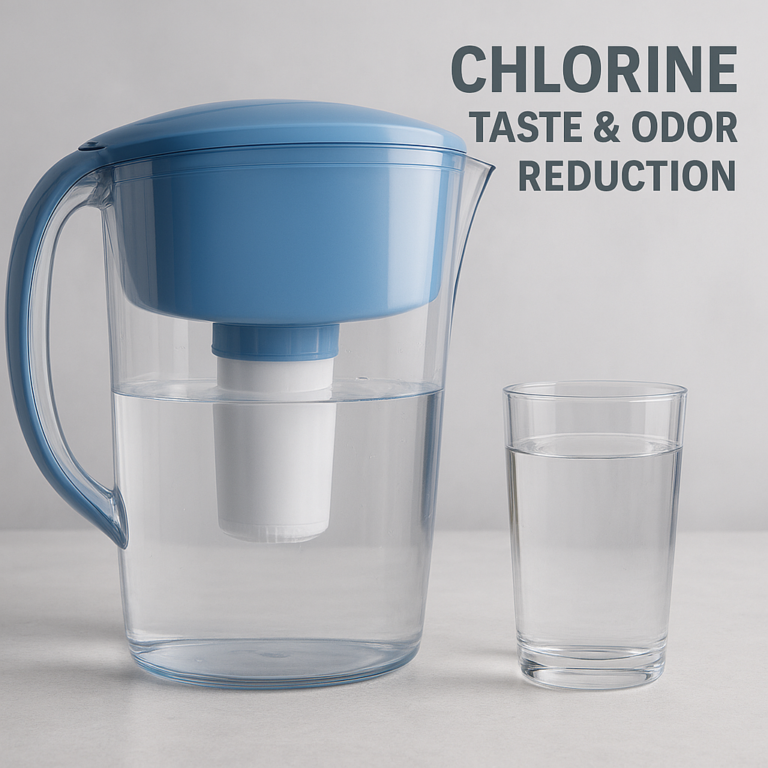
Pitchers are easy to start with: fill, wait, pour, repeat. They’re often a comfortable choice for renters and households that want chilled filtered water without installing a faucet. The tradeoff is volume. A large family can turn one pitcher into a part-time job.
When comparing pitchers, check:
- The exact cartridge model.
- Certified reductions and the standard attached to each claim.
- Gallon capacity and replacement interval.
- Whether the filter has been tested for your concern, not just chlorine taste.
Under-Sink and Countertop Filters
Under-sink systems can deliver filtered water from a dedicated faucet and may have higher capacity than pitchers. Countertop systems can be easier to install, though they still claim valuable real estate beside the kettle.
Before purchasing:
- Measure cabinet or counter space.
- Check whether the unit needs a separate faucet, power, or a drain connection.
- Confirm replacement cartridges are available for the exact model.
- Verify all certification claims in a directory.
Reverse Osmosis Systems
Reverse osmosis uses a membrane as part of a multi-stage treatment process. It can be a fit for certain water-quality concerns, but “RO” is a technology description, not proof of NSF/ANSI 401 certification. Look for the system’s actual listing and contaminant-specific claims. The EPA’s private-well guidance can help explain why testing and appropriate treatment selection matter for households using well water.
Also consider reject water, maintenance, and whether the system changes mineral content. If you like the taste of naturally mineralized water, compare the treated water with your preferences; some people enjoy the cleaner, lighter profile, while others miss the mineral character of mineral water.
Refrigerator and Whole-House Filters
Refrigerator filters are convenient, but their claims are cartridge-specific. Whole-house systems may help with issues affecting bathing, laundry, or plumbing, yet they aren’t automatically the right choice for every drinking-water concern. Match treatment to the point of use and the contaminant.
If your goal is better-tasting water for daily drinking, you may also compare filtered tap water with natural spring water or bottled water—but those categories are not substitutes for testing a household supply or verifying a filter’s claims.
🔍 How to Verify NSF/ANSI 401 Certification for a Specific Model
Here’s the part that saves shoppers from buying a familiar logo instead of a verified filter. We use the same process whether we’re checking a pitcher, an under-sink cartridge, or a refrigerator replacement.
Check the Exact Model Number and Certified Reduction Claims
- Find the model number on the product label, manual, packaging, or replacement cartridge.
- Search that model number in NSF’s product listings and IAPMO’s Product Listing Directory.
- Open the product record, not just the search result.
- Confirm NSF/ANSI 401 appears for the product or cartridge.
- Read the listed contaminants. Certification for one or more 401 substances does not equal reduction of every contaminant in the standard.
- Check other concerns separately. For example, confirm a lead claim if lead is your concern.
- Match the cartridge and capacity to the installation instructions.
- Recheck before buying replacements. Product listings and cartridge versions can change.
Search NSF, IAPMO, and Other Certification Directories
A reliable search includes:
- NSF Certified Product Listings
- IAPMO Product Listing Directory
- The product maker’s own certification page, cross-checked against a certifier
Certification may be granted by organizations other than NSF, so a product can be certified to an NSF/ANSI standard by another recognized certifier. The important question is whether the certifier’s listing identifies the exact product and standard.
Spot Misleading “Tested To” and “Mets Standards” Wording
Watch the difference:
- “Certified to NSF/ANSI 401” should be traceable to a certification listing.
- “Tested to NSF/ANSI 401” may describe testing but does not by itself prove current product certification.
- “Uses NSF-certified media” does not mean the complete filter is certified.
- “Mets NSF standards” needs a verifiable record and exact scope.
When we see a claim that lists “hundreds of contaminants,” we ask two questions: Which were independently certified? Which were only tested? That little distinction can turn an impressive table into a useful buying decision.
🛒 How to Choose a Water Filter for Emerging Contaminants
The best filter is the one that addresses your actual water concern, fits your home, and stays maintained. We recommend choosing in this order: water source → contaminant → verified claim → format → upkeep.
Match Certified Contaminant Reductions to Your Water Report
- Identify your water source: public utility, private well, or another supply.
- If you use municipal water, find the latest Consumer Confidence Report from your supplier. The EPA explains these reports in its drinking-water consumer resources.
- If you use a private well, arrange appropriate testing; private wells are not regulated under the same federal public-water framework. See the EPA’s private-well guidance.
- List the specific contaminants you want to address.
- Compare those names with the product’s certified reduction claims.
Don’t buy a filter because its contaminant list is long. Buy it because the right claim is on that list.
Consider Filter Capacity, Flow Rate, and Maintenance
A cartridge’s rated capacity and replacement instructions influence performance and convenience. A pitcher filter with a modest capacity may be perfectly fine for one person, while a family may prefer a higher-capacity under-sink option. Neither format wins automatically.
| Shopping factor | Why it matters |
|---|---|
| Gallon capacity | Indicates the manufacturer’s stated service life under specified conditions |
| Time-based replacement | Some makers specify both gallons and months; follow the first limit reached |
| Flow rate | Affects how long you wait for filtered water |
| Cartridge availability | Prevents maintenance from becoming a scavenger hunt |
| Change indicator | Helpful reminder, but follow the manual and capacity guidance |
| Installation requirements | Can add complexity even when the filtration claims are strong |
The CDC recommends using water-treatment devices according to manufacturer instructions. Our testers also recommend keeping a simple replacement note on the fridge. Not glamorous, but neither is discovering you’ve been postponing a filter change for three months.
Check Installation, Space, and Water Pressure Requirements
- Pitcher: measure shelf and fridge-door space.
- Faucet mount: check faucet shape and aerator compatibility.
- Under-sink: inspect cabinet space, plumbing access, and whether a dedicated faucet is needed.
- Countertop appliance: check dimensions and outlet access.
- RO system: review drain, tank, and pressure requirements.
The best technical specifications are less charming when the filter doesn’t fit beneath your sink. Measure first; your tape measure is cheaper than an ill-fitting appliance.
Compare Filter Costs Without Cutting Corners
We won’t rank filters by sticker price alone. Compare the full ownership picture:
- Replacement cartridge frequency and availability.
- Whether the system requires multiple cartridges.
- Installation needs.
- Rated capacity and household use.
- The value of the specific certified claim you need.
A short-lived cartridge can still suit a household with low water use; a high-capacity system may make more sense for a busy kitchen. Don’t pay for a long list of reductions you don’t need, but don’t sacrifice a relevant certified claim just to get a prettier pitcher.
🚰 NSF/ANSI 401 vs. NSF/ANSI 42, 53, 58, and 473
Different standards address different types of claims. A filter can be certified to more than one standard, but each claim should be checked separately.
| Standard | General focus | What it does not automatically mean |
|---|---|---|
| NSF/ANSI 42 | Aesthetic effects such as chlorine taste and odor | Lead or emerging-contaminant reduction |
| NSF/ANSI 53 | Health effects-related reduction claims for listed contaminants | Reduction of every health-related contaminant |
| NSF/ANSI 58 | Reverse-osmosis drinking-water treatment systems and specified claims | That every RO system has the same reductions |
| NSF/ANSI 401 | Reduction claims for a defined panel of incidental or emerging compounds | PFAS, lead, or all pharmaceuticals unless specifically listed |
| NSF/ANSI 473 | A standard associated with PFOA/PFOS drinking-water treatment claims | A guarantee that every 401-certified filter reduces PFAS |
For consumer guidance, see NSF’s water-filter information and the relevant certifier listing for your product. The standard number is a map legend; the actual product record is the map. 🗺️
🧼 Filter Installation, Cartridge Replacement, and Ongoing Care
A certified filter only performs as intended when installed and maintained according to its instructions.
A practical maintenance routine
- Read the manual before installation. Confirm the correct cartridge and flow direction.
- Flush or prepare the cartridge exactly as instructed.
- Write down the installation date and the rated capacity.
- Track gallons or time if the device provides a meter or reminder.
- Replace the cartridge at the stated limit. Follow whichever limit—gallons or time—comes first.
- Clean the housing or pitcher according to the manufacturer’s guidance.
- Recheck the replacement part number before ordering.
CDC advice on home water-treatment devices stresses that maintenance and proper use matter; see CDC’s household treatment guidance. One of our testers learned this the unglamorous way: the filter indicator was blinking, the refill was slow, and the “quick cup” before work had become a small kitchen ceremony. The fix wasn’t a stronger filter. It was replacing the cartridge on schedule.
🏠 Do You Need a Water Filter? Testing Tap Water and Reading Your Water Quality Report
Not every household needs an NSF/ANSI 401 filter. If your water tastes fine and your report doesn’t raise a concern, you may simply prefer a filter for taste—or choose no extra treatment. If you have a known contaminant concern, a private well, old plumbing, or a local advisory, take that concern seriously and choose treatment based on reliable information.
Where to start
- Public water: read the latest Consumer Confidence Report and contact your supplier with questions.
- Private well: test through a qualified laboratory and follow local or state guidance. The EPA’s private-well page explains key considerations.
- Lead concern: consider testing water and reviewing local health-department advice; lead can enter water through plumbing.
- Unusual taste, odor, or appearance: don’t assume a pitcher filter will solve the cause. Contact your supplier or a qualified professional.
The EPA’s Lead in Drinking Water information explains why identifying the source matters. A filter is one tool; testing and plumbing assessment may be necessary too.
If your goal is simply better flavor, a filter can make tap water more enjoyable. Some households also compare it with enhanced water or other drinking-water choices, but taste preference is personal and does not establish safety.
⚠️ Common NSF 401 Certification Mistakes to Avoid
- Assuming every product from a certified brand is certified. Certification is product-specific.
- Treating “tested to” as “certified.” Look for a directory listing.
- Assuming NSF/ANSI 401 covers PFAS or lead automatically. Verify a separate named claim.
- Confusing media certification with complete-system certification. The full product matters.
- Reading “removes X contaminants” as “certified to reduce all X.” Ask which claims are independently certified.
- Forgetting replacement cartridges. The certified system depends on the correct cartridge and maintenance.
- Trusting an old comparison chart over a current listing. Product lines evolve.
- Treating a high percentage as a universal result. Reduction can depend on the test conditions and the exact claim.
A competitor calls NSF certification an “absolute nonegotiable.” We agree with the spirit—independent verification matters—but not with turning one standard into a universal shopping rule. The right certification depends on the contaminant you need to address.
✅ Quick Tips for Buying an NSF/ANSI 401 Water Filter
- ✅ Search the exact model number, not only the brand.
- ✅ Confirm NSF/ANSI 401 in a recognized certification directory.
- ✅ Read which specific contaminants are listed.
- ✅ Verify separate claims for lead, chlorine, PFAS, or other concerns.
- ✅ Compare filter capacity, flow, replacement schedule, and installation.
- ✅ Use a water report or lab test to guide the purchase.
- ❌ Don’t assume “401-certified” means every emerging contaminant is reduced.
- ❌ Don’t keep using cartridges beyond the manufacturer’s stated limit.
- ✅ For a clearer walkthrough, the BOS Water video, “Guide: NSF Certifications for Water Filters (Most People Don’t Know This!),” covers home water-filter certifications and common pros and cons.