Support our educational content for free when you purchase through links on our site. Learn more
👟 Are 3D-Printed Shoes More Sustainable?

Are 3D-printed shoes more sustainable than traditional footwear? Sometimes—but the printer alone doesn’t make a shoe greener. The best candidates combine efficient material use with durable design, responsible materials, and a practical way to repair, reuse, or recycle the shoe.
That distinction became clear in a two-month review of Nexbie’s 3D-printed shoes. The tester praised their comfort and how easily water, sand, and mud drained away, but said long-term durability was still an open question. A promising start, then—not a lifetime guarantee.
Key Takeaways
- 3D printing can reduce some manufacturing waste and enable made-to-order production, but it still uses energy and can generate failed prints or finishing waste.
- Materials and lifespan matter more than the “3D-printed” label. Recycled content, lasting comfort, and repair options strengthen a shoe’s sustainability case.
- Recyclability depends on the whole shoe and local systems. A one-piece design may be easier to process, but it isn’t automatically recyclable.
- There’s no universal winner. Compare similar shoes across materials, manufacturing, transport, wear life, and end of life.
- Look for evidence, not green buzzwords: transparent material details, meaningful durability testing, and specific take-back or recycling plans.
Table of Contents
- ⚡️ Quick Tips and Facts
- 👟 What Are 3D-Printed Shoes?
- How Additive Manufacturing Makes Footwear
- Common 3D-Printing Methods and Shoe Materials
- 🕰️ Background: The Rise of 3D-Printed Footwear
- From Prototypes to Performance Shoes
- Notable Brands and Real-World Examples
- 🌱 Are 3D-Printed Shoes More Sustainable Than Traditional Footwear?
- Why the Answer Depends on the Whole Product Life Cycle
- How to Read Sustainability Claims and Life-Cycle Assessments
- 🏭 How 3D Printing Can Make Footwear Manufacturing More Sustainable
- Less Material Waste and More Efficient Production
- On-Demand Manufacturing and Inventory Reduction
- Local Production, Shipping, and Supply Chains
- Customization, Fit, and Made-to-Order Shoes
- 🧵 Materials Matter: Recycled, Bio-Based, and Fossil-Fuel Plastics
- TPU, TPE, PLA, and Other Printable Polymers
- Recycled Content and Material Traceability
- Biodegradable Does Not Always Mean Compostable
- ⚡ The Hidden Environmental Footprint of 3D-Printed Shoes
- Energy Use and Carbon Emissions
- Chemical Use, Microplastics, and Air Quality
- Water Use and Manufacturing Impacts
- Packaging and End-of-Life Waste
- 🛠️ Shoe Quality, Durability, Comfort, and Performance
- Do 3D-Printed Shoes Last as Long as Conventional Shoes?
- Cushioning, Breathability, Traction, and Fit
- Repairability and Replacement Parts
- ♻️ Recycling and End-of-Life: Can 3D-Printed Shoes Be Recycled?
- Single-Material Designs Versus Mixed-Material Shoes
- Take-Back Programs, Reuse, and Material Recovery
- What Happens When Shoes Reach Landfill or Incineration
- ⚖️ 3D-Printed Shoes vs. Traditional Footwear
- Sustainability Comparison at a Glance
- Where Conventional Shoe Manufacturing Still Has an Edge
- 🛍️ How to Choose More Sustainable 3D-Printed Shoes
- Questions to Ask About Materials and Manufacturing
- Labels, Certifications, and Claims to Check
- Care Tips to Extend the Life of Your Shoes
- 🔮 The Future of Sustainable 3D-Printed Footwear
- Material Innovation and Circular Shoe Design
- What Needs to Improve Before 3D Printing Scales
- ✅ Conclusion
- 🔗 Recommended Links
- ❓ FAQ
- Are 3D-printed shoes eco-friendly?
- Do 3D-printed shoes use less material?
- Are 3D-printed shoes recyclable?
- Are 3D-printed shoes durable enough for everyday wear?
- Which brands make 3D-printed shoes?
- 📚 Reference Links
⚡️ Quick Tips and Facts
- Short answer: 3D-printed shoes can be more sustainable than traditional footwear, but printing alone does not make a shoe eco-friendly. The strongest case comes from less manufacturing scrap, fewer components, made-to-order production, long service life, and a realistic end-of-life plan.
- The material matters. A shoe printed from virgin, fossil-based polymer may still carry a substantial footprint. Recycled or bio-based content can help, but claims need to be specific and independently verifiable.
- Durability can outweigh production savings. If a printed shoe lasts substantially longer and remains comfortable, it may reduce how many pairs you buy. But brand performance claims are not the same as independent, footwear-specific life-cycle evidence.
- Recycling is not automatic. A one-piece or single-material shoe may be easier to process than a glued, multi-material shoe, but collection systems and compatible recycling facilities still matter.
- 3D printing is not inherently low-carbon or low-water. Electricity source, resin or filament production, factory location, finishing, packaging, shipping, and disposal all influence the result.
- The practical buyer’s test: look for published material details, wear testing, repair or take-back options, and transparent environmental data—not just the words “printed” or “sustainable.”
- Water Brands™ note: Footwear’s environmental impacts include materials, energy, water, chemicals, and waste. For drinking-water filtration and related water topics, start with our guide to water filter brands, or browse filtered water, natural spring water, and mineral water. Shoe manufacturing and drinking-water quality are different subjects, but pollution prevention connects them.
| Quick fact | What it means for sustainability |
|---|---|
| Additive manufacturing builds an object layer by layer | It can reduce some subtractive waste, but supports, rejects, and unused material can still create waste. |
| Digital designs can support production on demand | Potentialy fewer unsold shoes, provided brands actually use made-to-order or carefully managed production. |
| A shoe can have fewer parts | Less assembly and glue may help, but a hard-to-recycle polymer is still a hard-to-recycle polymer. |
| Long-lasting products can reduce replacement demand | The benefit depends on real wear life, fit, repairability, and whether people keep wearing the shoes. |
| “Recyclable” is not the same as “recycled” | Collection, sorting, material compatibility, and local facilities determine what happens at end of life. |
👟 What Are 3D-Printed Shoes?
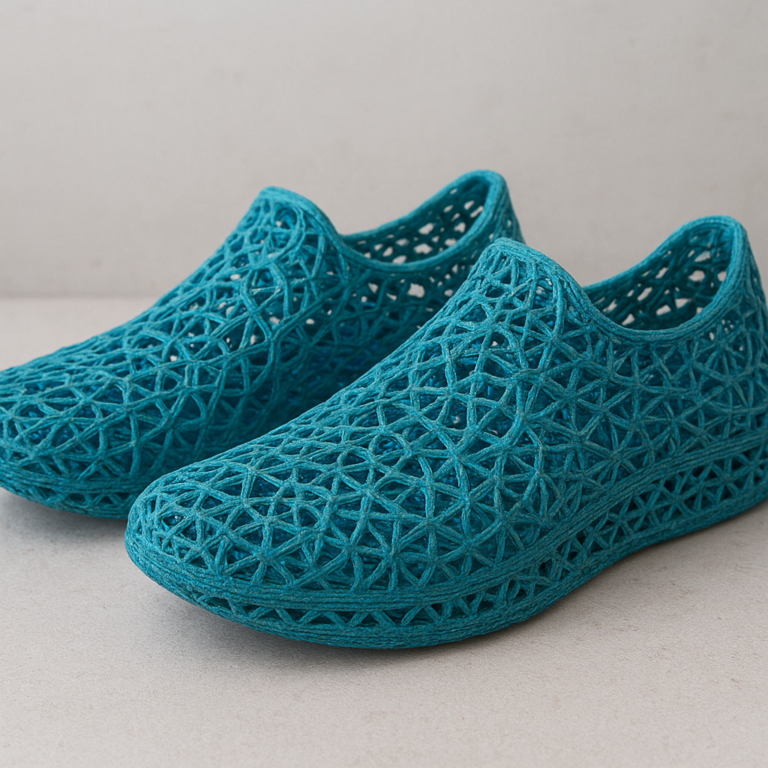
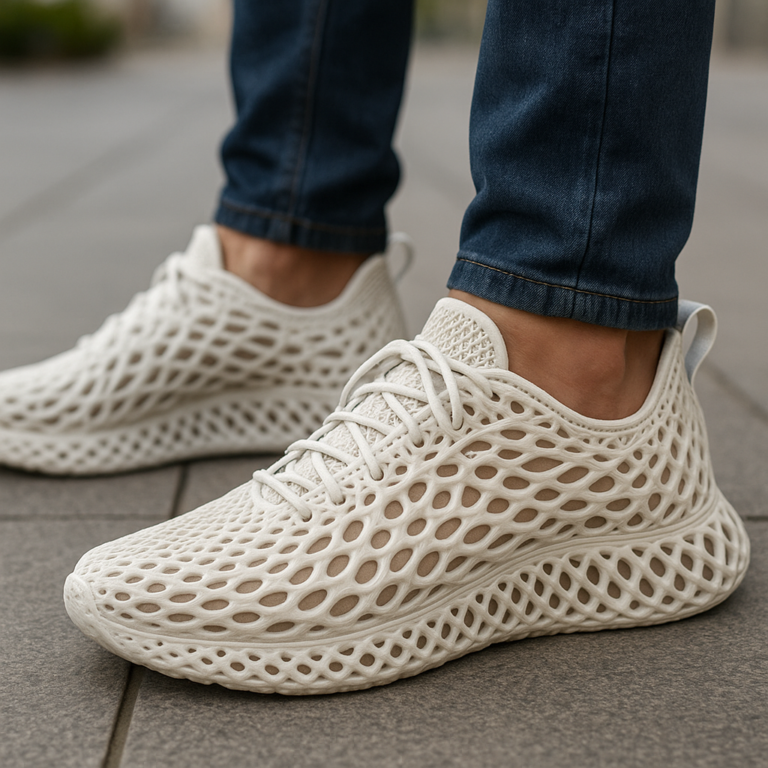
A 3D-printed shoe is made at least partly through additive manufacturing: a machine deposits or cures material according to a digital design. Some shoes have printed midsoles or lattice-like cushioning; others combine printed soles with conventional uppers; a smaller set aims for an almost entirely printed, one-piece construction.
That distinction matters. “3D-printed shoe” can describe anything from one printed component to a shoe whose upper, sole, and structure are all produced with printing technology. The sustainability profile changes with the design.
How Additive Manufacturing Makes Footwear
A conventional shoe usually involves numerous steps: making components, forming or cutting them, stitching or bonding them, and assembling them. The exact process varies by shoe. With 3D printing, a digital file guides a machine that builds selected structures in layers.
A simplified production sequence looks like this:
- Design the shoe digitally. Engineers model the shape, fit, cushioning pattern, and material distribution.
- Prepare the printable material. Depending on the process, it may be a polymer filament, powder, or liquid resin.
- Print the component or shoe. The printer forms the design layer by layer. Some methods require support structures; others use powder or specialized geometries to stabilize the build.
- Clean and finish the print. Excess powder or resin may need removal, and some parts require curing, trimming, or surface treatment.
- Asemble remaining components. A printed midsole may still be bonded to a conventional outsole or attached to a textile upper.
- Inspect and test. Fit, strength, cushioning, abrasion resistance, and product safety remain essential.
The U.S. National Institute of Standards and Technology (NIST) describes additive manufacturing as a broad family of processes, not a single low-impact technology. That is why “3D-printed” by itself tells us very little about the final footprint. NIST’s overview of additive manufacturing is a useful starting point.
Common 3D-Printing Methods and Shoe Materials
Different printing methods use different materials and have different requirements. Some footwear makers use polyurethane-based materials for cushioning; others use thermoplastic elastomers such as TPU. The printed material may also be only one part of a hybrid shoe.
| Material or process | Common footwear use | Potential benefit | Sustainability question |
|---|---|---|---|
| TPU (thermoplastic polyurethane) | Flexible soles, lattice midsoles, uppers | Tough, elastic, and suitable for complex structures | Is it virgin or recycled? Can it be recovered after use? |
| TPE (thermoplastic elastomer) | Flexible shoe components | Rubber-like flexibility with thermoplastic processing | What is its formulation, durability, and recycling pathway? |
| Polyurethane resin | Printed cushioning structures | Can be engineered for softness, rebound, and lattice geometries | What are the feedstocks, curing impacts, and end-of-life options? |
| PLA and other bio-based plastics | Prototypes and selected components | May contain renewable feedstock | “Bio-based” does not guarantee durable, recyclable, or home-compostable footwear. |
| Textiles and conventional foam | Hybrid uppers, lings, insoles, or soles | Familiar performance and established supply chains | Mixed materials and adhesives can complicate repair and recycling. |
A material label is only the beginning. We want to know the percentage of recycled or bio-based content, how that figure is calculated, and what can happen to the shoe after wear.
🕰️ Background: The Rise of 3D-Printed Footwear

3D printing has long been used to prototype shoe shapes and components. More recently, improvements in digital design, flexible polymers, and production systems have brought printed cushioning and full-shoe concepts closer to the consumer market.
The change is not simply “a printer replaces a factory.” Printing can alter how a shoe is designed, how many parts it uses, and whether production happens in large batches or closer to demand. But the technology still has to meet the same everyday tests as any shoe: comfort, safety, durability, grip, and fit.
From Prototypes to Performance Shoes
Early printed footwear often served as demonstrations or prototypes. Today, commercial products increasingly use printed lattice structures to tune cushioning and flexibility. A lattice can be designed to behave differently in different areas: softer under one part of the foot, firmer under another.
That design freedom is promising, but it can also produce a misleading sustainability story. A technically impressive lattice is not automatically a more responsible product. We still need to ask how much material it uses, how much energy printing requires, and whether the shoe lasts longer in real use.
Notable Brands and Real-World Examples
Brands and manufacturers associated with 3D-printed or digitally manufactured footwear include Zellerfeld, Nexbie, adidas, and LuxCreo. Their products and approaches are not interchangeable: some focus on fully printed designs, while others use printed midsoles or specialized cushioning systems.
- Zellerfeld is known for fully printed footwear concepts and collaborations.
- Nexbie offers 3D-printed footwear; a reviewer’s two-month daily-wear test is discussed below.
- adidas 4D footwear uses a digitally produced lattice midsole developed with Carbon’s Digital Light Synthesis technology.
- LuxCreo develops 3D-printing technologies and materials for footwear and other applications.
These examples show that “3D-printed shoe” can mean a printed sole, a printed structural midsole, or a largely one-piece product. When comparing products, check what is actually printed and what other materials are attached.
🌱 Are 3D-Printed Shoes More Sustainable Than Traditional Footwear?
Sometimes—but there is no universal winner. 3D printing can reduce some kinds of waste, simplify construction, and make customized or on-demand production more practical. Traditional footwear can benefit from mature supply chains, established high-volume processes, and material recovery systems where available.
The fairest answer depends on the whole life cycle, from raw material extraction to manufacturing, transport, use, and end of life. The European Commission’s Product Environmental Footprint approach similarly emphasizes assessing multiple environmental impacts across a product’s life rather than judging it by one feature alone. European Commission: Environmental Footprint methods
Why the Answer Depends on the Whole Product Life Cycle
A shoe’s footprint may be affected by:
- Raw materials: petroleum-based polymers, rubber, textiles, recycled feedstocks, and bio-based inputs.
- Production: printing energy, molding energy, cutting waste, rejected parts, curing, and assembly.
- Distribution: shipping components or finished shoes, warehousing, and returns.
- Use phase: how long the shoe remains comfortable and functional, and how it is cleaned or repaired.
- End of life: reuse, take-back, recycling, incineration, or landfill.
| Life-cycle stage | Possible 3D-printing advantage | Important caveat |
|---|---|---|
| Materials | Precise placement may use material more efficiently | Printable polymers may still be fossil-based or difficult to recycle |
| Manufacturing | Fewer components and less cutting scrap are possible | Supports, failed prints, cleaning, and finishing also consume resources |
| Distribution | Digital files and localized production may reduce some shipping | Local printing is not automatically lower-carbon if electricity or logistics are inefficient |
| Use | Custom geometry or durable cushioning may improve wear life | Better performance claims need independent, real-world testing |
| End of life | Monomaterial construction may simplify recovery | Collection and recycling infrastructure may be missing |
LuxCreo argues that 3D printing can reduce production waste and extend footwear life, including claims about its LEAP technology’s resistance to repeated heel strikes. Those claims are relevant as a manufacturer’s perspective, not proof of a universal advantage: the available article does not provide a full comparative life-cycle assessment of a particular printed shoe against a traditional shoe. See LuxCreo’s footwear sustainability discussion.
A LinkedIn post by footwear professional Tim Downing makes a related supply-chain argument: a conventional shoe can involve many components and processes, while some printed designs may use only one or two materials and processes. That is a useful manufacturing perspective, but it also does not establish a quantified overall environmental win. Read the post.
How to Read Sustainability Claims and Life-Cycle Assessments
When you see “lower impact,” “zero waste,” or “more sustainable,” look for the comparison behind the claim.
A helpful life-cycle comparison should specify:
- The products compared: similar purpose, performance, size, and expected service life.
- The functional unit: for example, one pair used for a defined number of kilometers or years—not merely one shoe.
- System boundaries: which materials, factory steps, transport routes, use, and disposal are included.
- Impact categories: greenhouse-gas emissions, water use, energy, pollution, and waste—not carbon alone.
- Data quality: measured factory data or modeled estimates, and whether the study is independently reviewed.
- End-of-life assumptions: actual recycling routes, not simply a theoretical “recyclable” label.
A shoe that uses fewer grams of material may still have a higher total impact if its material is energy-intensive or it wears out sooner. Conversely, a heavier shoe may perform better over a longer service life. The useful comparison is impact per wear or per service delivered, not just impact per pair.
🏭 How 3D Printing Can Make Footwear Manufacturing More Sustainable
The strongest sustainability case for additive manufacturing is not that it magically eliminates impacts. It is that it may give designers and manufacturers more control over material use, product structure, batch size, and location.
The word to keep in mind is may. These benefits depend on how a manufacturer uses the technology and what it measures.
Less Material Waste and More Efficient Production
Traditional processes can create offcuts, trim waste, sprues, or other production scrap depending on the process. 3D printing builds material where the design requires it, which can reduce some forms of waste. But printing can generate supports, failed builds, excess powder or resin, and post-processing waste.
A carefully designed lattice may use less material than a solid structure while preserving cushioning. It can also place material strategically instead of using the same density everywhere.
What to verify:
- Does the manufacturer report scrap or yield rates?
- Is unused material reused, recycled, or discarded?
- Does the shoe require supports or extensive finishing?
- Is the printed structure genuinely lighter or more material-efficient than a comparable shoe?
LuxCreo’s overview of sustainable manufacturing with 3D printing highlights reduced scrap, design consolidation, and on-demand production as potential benefits. Those are plausible pathways, but a quantified comparison is needed to determine the real-world result.
On-Demand Manufacturing and Inventory Reduction
Shoes are often produced in sizes, colors, and styles months before demand is known. Digital production could make shorter runs or made-to-order manufacturing more feasible, potentially reducing unsold inventory.
That benefit is not automatic. A brand can print shoes and still overproduce, hold inventory, or dispose of unpopular designs. On-demand production only helps if it changes production planning, not just the machine used.
Local Production, Shipping, and Supply Chains
A digital shoe file can, in principle, be sent to a production site closer to customers. This could reduce some long-distance shipping of finished products or components. Yet local manufacturing needs equipment, electricity, materials, skilled labor, and delivery logistics.
Transport is only one part of a shoe’s footprint. If material production remains far away, or the local printer uses carbon-intensive electricity, the benefit may be smaller than the slogan suggests.
Customization, Fit, and Made-to-Order Shoes
Digital design can support customized geometry, size adjustments, or personalized cushioning. A better-fitting shoe may be more likely to stay in use rather than being returned or abandoned.
But custom fit needs careful validation. A foot scan does not automatically diagnose foot mechanics, and a badly chosen shape can be uncomfortable. People with persistent pain or foot conditions should seek advice from a qualified podiatrist or clinician rather than relying on a marketing promise of “perfect fit.”
🧵 Materials Matter: Recycled, Bio-Based, and Fossil-Fuel Plastics
A printed shoe’s environmental story begins before the printer turns on. Material feedstock, formulation, processing, durability, and recovery route all matter.
“Bio-based,” “recycled,” and “biodegradable” describe different things. A bio-based polymer may still be durable plastic. A recyclable polymer may never be collected. A recycled-content claim does not tell us whether the product itself can be recycled after use.
TPU, TPE, PLA, and Other Printable Polymers
TPU and related elastomers are useful in footwear because they can bend and recover. Polyurethane resins can be engineered for cushioning structures, while PLA is often associated with bio-based feedstocks and protyping.
For finished shoes, the question is not only whether a material can be printed. It must also withstand repeated flexing, sweat, heat, abrasion, and exposure to the conditions it is designed for. A material that fails early can erase production-stage savings by forcing earlier replacement.
Recycled Content and Material Traceability
Recycled material can reduce reliance on virgin feedstocks, but brands should provide specifics:
- What percentage is recycled?
- Is the source post-consumer or post-industrial?
- Does the percentage refer to the shoe, a component, or the resin batch?
- Has the performance been tested across the product’s intended life?
- Can the manufacturer trace the material through the supply chain?
A vague “made with recycled material” statement is not enough to compare products. Look for component-specific percentages and documentation.
Biodegradable Does Not Always Mean Compostable
A biodegradable claim needs conditions: temperature, moisture, microbes, time, and the disposal environment. A shoe left in a landfill, roadside ditch, ordinary household compost bin may not break down as advertising implies.
The U.S. Federal Trade Commission’s Green Guides caution that environmental marketing claims should be clear and substantiated; unqualified biodegradability claims can mislead if a product does not break down within a reasonably short time after customary disposal. FTC Green Guides.
So, if a shoe’s material is described as biodegradable, ask where and under what conditions it has been tested. “Bio-based” is not the same as “compostable,” and neither term guarantees that a complete shoe can be safely composted.
⚡ The Hidden Environmental Footprint of 3D-Printed Shoes
Printing can make a cleaner-looking production story, but environmental impacts do not disappear just because the factory produces less visible scrap. The electricity, chemical inputs, material supply, finishing, and disposal still count.
Energy Use and Carbon Emissions
3D printers consume electricity, and the amount varies by technology, print time, curing, and factory setup. The material itself may also require energy-intensive processing. A factory using renewable electricity may have a different footprint from an otherwise identical factory using a carbon-intensive grid.
A proper comparison should report energy and emissions per comparable shoe or, better, per unit of wear. “Less material” and “lower carbon” are separate claims; one does not prove the other.
Chemical Use, Microplastics, and Air Quality
Some printing methods use resins, solvents, powders, or other processing aids. Proper workplace controls, ventilation, handling, and disposal matter. The exact risks depend on the material and process, so avoid generalizing from one printer type to all additive manufacturing.
During use and disposal, plastic products can contribute to environmental persistence and fragmentation. The U.S. Environmental Protection Agency’s overview of plastic pollution explains why reducing leakage and improving waste management matter beyond the factory gate.
Water Use and Manufacturing Impacts
There is no simple rule that 3D-printed shoes use less water than conventional shoes. Footwear water use varies with raw-material production, textile dyeing and finishing, cleaning, cooling, and factory processes. A printed polymer sole may avoid some water-intensive steps, while a shoe’s textile upper may still require conventional material processing.
If a brand claims “water-saving,” look for a clear boundary and a comparison with a similar product. The same standards we use when evaluating bottled water or enhanced water claims apply here: specific evidence beats a broad green label.
Packaging and End-of-Life Waste
A lighter or more compact product could reduce packaging or shipping volume, but packaging choices depend on the brand. At end of life, a shoe may be reused, repaired, collected, recycled, incinerated, or landfilled.
The European Environment Agency describes footwear as a challenging waste stream partly because shoes can combine different materials and components. EEA: textiles and the environment provides broader context on textile waste and circularity.
🛠️ Shoe Quality, Durability, Comfort, and Performance
A more sustainable shoe is not much help if it is uncomfortable or wears out quickly. Performance affects the environmental equation because a shoe that stays in use longer can reduce replacement demand.
That does not mean every printed shoe is more durable than every conventional shoe. Product design, material, fit, manufacturing quality, and use conditions all matter.
Do 3D-Printed Shoes Last as Long as Conventional Shoes?
We found an encouraging but not definitive real-world perspective in a review of Nexbie footwear. The reviewer wore professionally manufactured 3D-printed shoes daily for two months across work, walking, beach trips, fishing, golf, and camping. They praised comfort, drainage, and the way sand and dried mud fell from the lattice. The reviewer also said long-term durability remained an unanswered question.
That is a useful personal experience, not a controlled durability study. Two months of wear can reveal comfort and everyday practicality, but it cannot establish a product’s full service life.
LuxCreo has published claims that its LEAP technology maintains performance through many more heel-strike cycles than some foam comparisons. Because those are company-reported results and may depend on test conditions, treat them as product-specific claims, not a general finding about all printed footwear. See LuxCreo’s explanation.
Cushioning, Breathability, Traction, and Fit
Printed lattice structures can create open geometry that supports ventilation and drainage. The Nexbie reviewer found that water drained quickly and debris cleared as the shoe flexed. That sounds useful for wet or sandy environments, though open structures may be less suitable for cold weather, fine dust, or settings where a closed upper is preferred.
When trying a printed shoe, consider:
- Cushioning: Does it remain comfortable after a full day?
- Fit: Is the shoe secure without pressure points?
- Traction: Does the outsole grip the surfaces you actually use?
- Breathability: Does the structure ventilate without sacrificing protection?
- Cleaning: Can trapped dirt be removed easily?
- Support: Is the design appropriate for your feet and activities?
The reviewer described comfort for extremely flat feet, but one person’s experience is not medical guidance or proof that the shoe will suit everyone. If a shoe causes pain, stop wearing it and seek professional advice.
Repairability and Replacement Parts
Repair can extend a shoe’s life, but one-piece construction may complicate replacing a worn outsole or damaged section. Hybrid shoes may be easier to repair if their components can be separated, though adhesives and mixed materials can make that difficult.
Before buying, check whether the brand offers replacement components, repairs, or a take-back program. If a product is described as “designed for circularity,” look for a concrete service—not just a design claim.
♻️ Recycling and End-of-Life: Can 3D-Printed Shoes Be Recycled?
Sometimes in theory; often difficult in practice. A shoe made from one compatible material may be easier to recycle than a conventional shoe combining rubber, foam, textiles, plastics, threads, and adhesives. But the shoe must be collected, sorted, processed, and accepted by an available facility.
Single-Material Designs Versus Mixed-Material Shoes
A monomaterial design can make disassembly and material identification simpler. A one-piece shoe may also avoid some adhesives. But “one piece” does not automatically mean “recyclable.” Its polymer must be recoverable into a useful material, and the recycling route must exist at scale.
Hybrid shoes may include a printed midsole, textile upper, liner, insole, and outsole. That can complicate separation, especially if components are bonded.
Take-Back Programs, Reuse, and Material Recovery
A brand take-back program is useful only if it explains what happens next. Does the shoe get resold, repaired, downcycled, mechanically recycled, or chemically processed? Is the program available where you live?
Before sending footwear to a collection bin, check the program’s accepted materials and conditions. Some textile take-back schemes do not accept all types of footwear, and household recycling programs rarely handle shoes.
What Happens When Shoes Reach Landfill or Incineration
If a shoe is not reused or recycled, it may be landfilled or incinerated, depending on local waste systems. Durable synthetic materials can persist, while burning waste may create emissions that require appropriate controls.
The useful sustainability goal is not simply “make the shoe recyclable.” It is prevent premature disposal, enable repair and reuse, and make material recovery practical. That requires product design and a functioning collection system.
⚖️ 3D-Printed Shoes vs. Traditional Footwear
There is no single shoe type that wins every sustainability category. A well-designed printed shoe can outperform a poorly made conventional one in waste or longevity. A conventional shoe made with durable, lower-impact materials and an established repair or recovery pathway may outperform a printed shoe made from virgin polymer with no end-of-life plan.
| Factor | 3D-printed footwear | Traditional footwear |
|---|---|---|
| Material waste | Can reduce cutting waste and use material strategically | Cutting, molding, and assembly may create scrap, depending on process |
| Components | May combine parts or use fewer materials | Often includes multiple materials and bonded components |
| Production scale | Flexible for customization and shorter runs | Mature systems can be efficient at high volume |
| Inventory | On-demand models are possible | Batch production can result in excess stock, though not always |
| Energy | Printer and finishing energy vary by process | Molding, textile processing, and assembly energy vary by product |
| Durability | Potential for tuned structures and robust polymers | Broad range from short-lived fashion shoes to highly durable footwear |
| Recycling | Monomaterial designs may simplify recovery | Mixed materials and adhesives can make separation difficult |
| Evidence | Product-specific claims are growing; comparative data remain limited | More established supply chains, but full impact data may also be limited |
Where Conventional Shoe Manufacturing Still Has an Edge
Traditional footwear production benefits from established supplier networks, known materials, large-scale manufacturing, and wide consumer availability. Some conventional shoes are designed to be resoled or repaired, while many printed models are still relatively new and have limited long-term wear data.
A LinkedIn post about printed footwear describes the potential for simpler construction and localized production, while commenters caution that additive manufacturing is “not a panacea.” That’s the right caution. Printing may make a dent in footwear manufacturing, but adoption, scale, comfort, performance, and end-of-life systems all take time to mature. See the discussion.
🛍️ How to Choose More Sustainable 3D-Printed Shoes
A good buying decision starts with the shoe’s actual use. A lightweight lattice sandal is not a sensible replacement for a protective work boot, and a premium printed runner is not automatically better for the planet if it sits unworn in a closet.
Questions to Ask About Materials and Manufacturing
Use this checklist before buying:
- What part is printed? The entire shoe, the midsole, or one small component?
- What is the material? Look for polymer type and recycled or bio-based content.
- Is the product tested for durability? Seek independent or clearly described testing.
- Can the shoe be repaired? Check for replacement parts and repair services.
- What happens at end of life? Look for a real take-back or recycling route.
- Is production made-to-order? A digital process does not prove the company avoids overproduction.
- Are environmental claims quantified? Prefer a product-specific life-cycle assessment or transparent data.
- Does it fit your needs? The most sustainable shoe is one you can wear comfortably for a long time.
Labels, Certifications, and Claims to Check
No single label settles the question. Look for independently verified information and clear scope. If a shoe carries a recycled-content claim, check whether it applies to the whole shoe or just one component. If a brand claims low carbon or low water use, ask what product was used for comparison and which life-cycle stages are included.
The FTC’s Green Guides offer practical guidance for evaluating environmental marketing claims in the United States. For broader product assessment, the European Commission’s Environmental Footprint methods explain why multiple impact categories and consistent comparisons matter.
Care Tips to Extend the Life of Your Shoes
Longer use is one of the clearest ways to get more service from a pair you already own.
- Follow the manufacturer’s cleaning instructions; do not assume every polymer tolerates high heat.
- Let wet shoes dry fully before wearing them again.
- Remove grit and mud from lattice structures before it accumulates.
- Rotate footwear if you wear the same pair daily.
- Replace worn insoles or laces when possible rather than discarding the whole shoe.
- Stop using shoes when cushioning, traction, or structural integrity has deteriorated.
🔮 The Future of Sustainable 3D-Printed Footwear
The technology’s environmental promise will depend less on futuristic shapes than on better materials, better durability data, and practical circular systems.
Material Innovation and Circular Shoe Design
Potential improvements include recycled feedstocks, lower-impact polymers, designs that separate cleanly, and systems that recover material into new products. Monomaterial construction may help, but designers also need to account for comfort, traction, colorants, additives, and performance.
The strongest future model would combine durability, repairability, transparent material sourcing, and a verified recovery route. A printable shoe that can be worn for years and returned into a usable material stream would make a much stronger case than one that is merely easy to manufacture.
What Needs to Improve Before 3D Printing Scales
Before printed footwear can claim broad sustainability advantages, manufacturers and researchers need:
- More independent, comparable life-cycle assessments.
- Transparent data on energy, material yield, scrap, and rejects.
- Long-term wear testing across different users and use cases.
- Clear documentation of recycled and bio-based content.
- Scalable collection and recycling options.
- Evidence that on-demand manufacturing reduces overproduction in practice.
One final perspective comes from a reviewer who tested Nexbie shoes through two months of varied daily use. They were impressed enough that a gray Airscape model became a regular choice, praising its comfort and ability to shed water, sand, and mud. Yet they called long-term durability one of the biggest unanswered questions. That combination—real enthusiasm, alongside a clear caveat—is exactly the balance we need. The shoes may no longer be a gimmick, but their overall sustainability still depends on what happens after the first few months of wear.