Support our educational content for free when you purchase through links on our site. Learn more
What Materials Make 3D-Printed Shoes? 👟

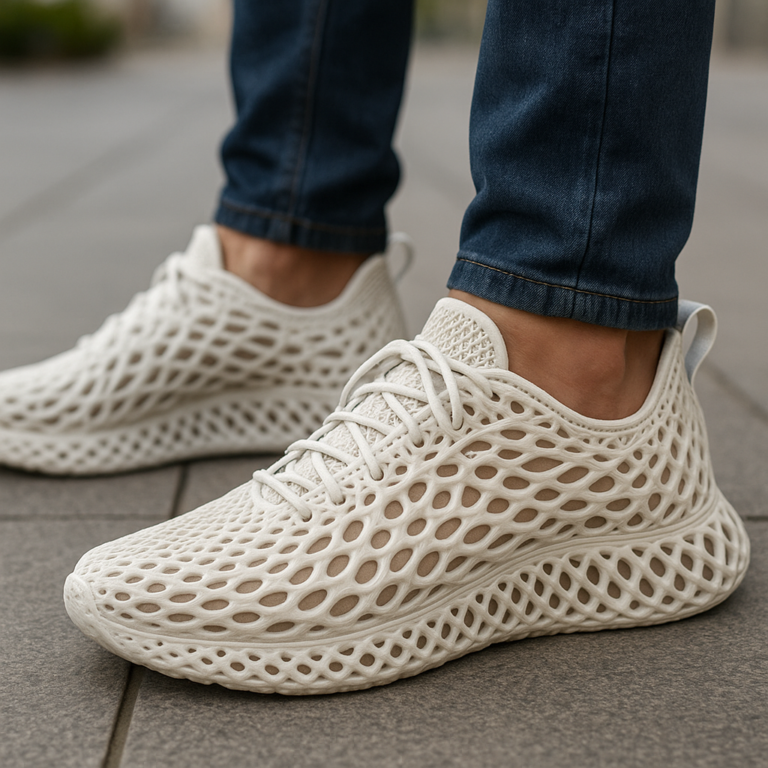
Most 3D-printed footwear is made from flexible plastics—especially TPU and other thermoplastic elastomers—while some designs combine printed parts with conventional fabric, foam, or rubber. The answer to “What materials are used to make 3D-printed footwear?” depends on the shoe’s components, printing method, and intended use.
The material name alone doesn’t tell you how a shoe will feel. A TPU lattice can be soft and springy or surprisingly firm, depending on its formulation and printed geometry. In a video demonstration, flexible filament even changes its behavior with temperature and print settings—a reminder that making a wearable shoe takes more than feeding plastic into a printer.
Key Takeaways
- TPU and other flexible elastomers are common materials for 3D-printed soles, midsoles, uppers, and lattice structures.
- A 3D-printed shoe may combine several materials. Printed parts can be joined with conventional textiles, insoles, or other components.
- Material and design work together: polymer formulation, lattice geometry, fit, and manufacturing method all influence comfort and durability.
- Recycled, bio-based, and biodegradable are different claims. Check the manufacturer’s documentation rather than relying on labels alone.
- Look for exact material details, care guidance, and product-specific testing before choosing footwear.
Table of Contents
- ⚡️ Quick Tips and Facts
- 👟 What Materials Are Used to Make 3D-Printed Footwear?
- 🕰️ How 3D-Printed Shoes Have Evolved
- 🧪 The Main Materials in 3D-Printed Footwear
- 1. Thermoplastic Polyurethane (TPU)
- 2. Thermoplastic Elastomers (TPE)
- 3. Flexible Filaments: TPU Blends and Other Elastomers
- 4. Nylon and Other Engineering Thermoplastics
- 5. Photopolymer Resins for 3D-Printed Shoe Components
- 6. Recycled and Bio-Based 3D-Printing Materials
- 🦶 Materials by Shoe Component: Uppers, Midsoles, and Outsoles
- 3D-Printed Shoe Uppers and Lattice Structures
- Cushioning Materials for Midsoles
- Durable, Grippy Materials for Outsoles
- Insoles, Lings, and Traditional Shoe Components
- 🖨️ How 3D-Printed Footwear Is Made
- Fused Filament Fabrication and Filament Choices
- Selective Laser Sintering and Powder Materials
- Resin Printing and Other Additive Manufacturing Methods
- 🔬 How Material Properties Affect Comfort and Performance
- Flexibility, Cushioning, and Energy Return
- Breathability, Heat, and Moisture Management
- Grip, Abrasion Resistance, and Durability
- Fit, Weight, and Customization
- 🧤 Are 3D-Printed Shoe Materials Safe to Wear?
- ♻️ Sustainability: Recycled Plastics, Waste, and End of Life
- 🆚 3D-Printed Footwear vs. Conventional Shoes
- ✅ Are 3D-Printed Shoes Worth It?
- 🛍️ Notable 3D-Printed Footwear Brands and Material Examples
- 💡 How to Choose 3D-Printed Shoes for Your Needs
- 🧼 Care, Cleaning, and Repair Tips
- 🔮 The Future of 3D-Printed Shoe Materials
- 🏁 Conclusion
- 🔗 Recommended Links
- ❓ FAQ
- What is the most common material used in 3D-printed shoes?
- Are 3D-printed shoes made entirely of plastic?
- Is TPU comfortable and durable for footwear?
- Can 3D-printed shoes be recycled?
- Are 3D-printed shoes waterproof or breathable?
- Can you 3D-print a whole shoe at home?
- 📚 Reference Links
⚡️ Quick Tips and Facts
- Most 3D-printed footwear is made from flexible polymers, especially thermoplastic polyurethane (TPU) and other thermoplastic elastomers (TPE). The exact formula varies by product, printer, and intended use.
- “3D-printed” describes how a shoe is made, not what it’s made of. A printed lattice midsole may be paired with conventional fabric, foam, rubber, or other components.
- TPU is a frequent choice for flexibility and abrasion resistance, but softness, rebound, grip, and durability depend on the specific grade and the shoe’s geometry—not just the material name. BASF’s overview of TPU explains the range of properties possible within this material family.
- Some foaming filaments are designed to expand during printing. In the featured video, the presenter compares Roamr TPU Air with traditional TPU and PEBA Air, emphasizing bounce and softness while also showing why print settings matter.
- Material names and marketing claims are not always full specifications. Ask for the polymer type, product-specific test data, care instructions, and whether the shoe is fully printed or assembled from mixed materials.
- For comfort, check the whole design: fit, underfoot structure, ventilation, seams, and sock compatibility matter as much as the polymer.
- If you’re comparing water-related products while reading, Water Brands™ also covers water filter brands, plus bottled water and filtered water. Shoes, thankfully, don’t need a hydration strategy—but your feet may appreciate a breathable design.
| At a glance | What it usually means |
|---|---|
| Common footwear polymers | TPU and other flexible TPE formulations |
| Common printed parts | Soles, midsoles, lattices, and occasionally whole-shoe structures |
| Common production methods | Fused filament fabrication (FFF/FDM) and powder-bed processes such as selective laser sintering (SLS) |
| Possible nonprinted parts | Insoles, liners, fabrics, adhesives, and conventional rubber components |
| Best first question to ask | Which exact material is used in this shoe, and what product-specific testing supports its claims? |
👟 What Materials Are Used to Make 3D-Printed Footwear?
Most 3D-printed shoes use flexible thermoplastic polymers, particularly TPU or related elastomers. These plastics can bend and compress, making them better suited to footwear than rigid materials such as standard PLA. Depending on the design, a shoe may be printed as a single connected structure or built from printed parts combined with conventional components.
The phrase “3D-printed shoe” can therefore cover several very different constructions:
- A fully printed shoe, where the upper and sole are formed from a printable polymer.
- A printed midsole or outsole, attached to a fabric or knit upper.
- A printed lattice structure, tuned to provide cushioning or flexibility.
- A custom-fit printed shoe, shaped using a person’s measurements or a digital foot scan.
The short answer: flexible polymers lead the pack
| Material family | Typical footwear use | Potential strengths | Limitations to check |
|---|---|---|---|
| TPU | Soles, midsoles, uppers, lattice structures | Flexible; available in a wide range of hardnesses; some grades resist abrasion | Feel varies by grade and geometry; printing can require careful settings |
| TPE and TPU blends | Flexible printed parts | Can be formulated for different softness and elasticity | “TPE” is a broad category, not one specific material |
| Foaming or expandable TPU | Lightweight midsoles and cushioning | Can expand during printing to create a lighter, more compliant structure | Results depend on temperature, flow, and slicer settings |
| Nylon and other engineering plastics | Structural or supporting components | Can provide stiffness or strength for certain designs | Not automatically comfortable or suitable for skin-contact areas |
| Photopolymer resin | Specialized prototypes or selected components | Fine detail can be possible | Resin suitability, flexibility, and post-processing must be verified for the intended wear |
| Recycled or bio-based polymers | Some product lines or experimental materials | May reduce reliance on virgin fossil-based feedstock | “Recycled” or “bio-based” does not by itself prove lower overall impact or recyclability |
A caution about labels: “TPU,” “foam,” “bio-based,” and “recycled” each describe different things. A TPU may be foamed; a polymer may contain recycled feedstock; and a bio-based ingredient does not necessarily make the finished shoe biodegradable. Product-specific documentation is the useful part—not a bold word on the box.
The broad material category is only the beginning. The same polymer can feel springy in one lattice and stiff in another, which is why we’ll look at both the material and the architecture.
Why not print every shoe from one material?
A shoe has competing jobs. It should cushion, flex, support, grip, stay on your foot, and manage heat and moisture. A material optimized for soft cushioning may not offer the best outsole wear. A rigid component may help with structure but feel unforgiving as an upper.
That’s why many designs mix materials or combine a printed structure with familiar shoe components. Even a shoe advertised as “printed in one piece” may still include separate insoles, laces, or finishing elements. Check the construction details rather than assuming the whole shoe is one material.
🕰️ How 3D-Printed Shoes Have Evolved
Early consumer interest in 3D-printed footwear centered on the technology’s ability to create unusual shapes and customized structures. Additive manufacturing builds an object layer by layer, allowing designers to produce intricate lattices and internal geometries that can be difficult to make with conventional molding. The National Institute of Standards and Technology (NIST) describes additive manufacturing as a family of processes that builds objects from digital models, layer by layer.
Footwear designers have used those capabilities to explore:
- Personalized fit, including shoes designed from digital measurements.
- Lattice midsoles with carefully varied density and shape.
- Reduced part counts in some designs.
- Rapid design iteration, where a geometry can be revised digitally before another sample is made.
But a newer manufacturing method doesn’t automatically mean a better shoe—or a greener one. Performance still depends on the polymer, the design, the manufacturing process, and how long the product lasts.
Custom-fit claims need evidence
The summary of a video about Zellerfeld describes a German production operation using 200 machines and mentions custom-fit footwear. Its description calls the project “3D-printing the shoes of tomorrow,” but does not identify the polymer or provide material test data. That’s an evocative headline, not a materials specification.
For a custom-fit claim, look for practical details:
- How is the foot measured? A scan, a measurement chart, and an in-person fitting are not equivalent methods.
- What parts of the shoe are customized? Length, width, arch area, instep volume, or the entire shape?
- Can the fit be adjusted after delivery?
- Is there evidence from wear testing or user feedback?
- Does the product disclose its material and care guidance?
A custom shape may improve fit for some wearers, but it cannot compensate for a poorly chosen material or an unsuitable design.
What the video summaries do—and don’t—tell us
The available summary of the Zellerfeld video focuses on production scale and custom-fit shoes, not the polymer used. Likewise, the accessible summary of Kingroon’s 3D-printing article is an age-verification screen rather than material guidance. Siraya Tech’s page is titled “3D-printed shoes filament,” but the provided page summary doesn’t identify a specific footwear filament or its specifications. We shouldn’t fill those gaps by guessing.
That distinction matters: a product category page or video headline is not a substitute for a technical data sheet. When the exact material isn’t disclosed, the honest answer is that it cannot be confirmed from that source.
🧪 The Main Materials in 3D-Printed Footwear
1. Thermoplastic Polyurethane (TPU)
TPU is a family of thermoplastic elastomers used in applications that need a balance of flexibility and strength. In footwear, it’s commonly discussed for printed soles, cushioning structures, and flexible uppers. BASF’s Elastollan TPU information illustrates how TPU grades can be engineered for different properties.
Potential benefits
- Can be formulated across a range of hardnesses and flexibility.
- Can support elastic, bendable designs.
- May provide useful resistance to wear, depending on the specific grade and construction.
- Can be printed into lattices or other customized geometries.
Potential drawbacks
- TPU is not one uniform material; one grade can feel very different from another.
- Flexible filament may be more sensitive to printer setup than rigid filament.
- A soft shoe can feel comfortable initially yet lack the support or stability a particular wearer wants.
- “Durable TPU” is not a guarantee of a long-lasting shoe without product-specific testing.
Our practical read: TPU is a sensible material family to look for in flexible printed footwear, but we wouldn’t buy on the acronym alone. Ask what grade is used, where it appears in the shoe, and how the manufacturer tested abrasion, flexing, and wear.
2. Thermoplastic Elastomers (TPE)
TPE is an umbrella term for materials with rubber-like flexibility that can be processed as thermoplastics. TPU is one type of thermoplastic elastomer, so the terms are related rather than interchangeable. The precise formulation determines how a TPE behaves.
A manufacturer that says only “TPE” has provided a broad family name, not a complete material description. Look for a datasheet or a clear product specification that explains:
- The particular polymer or blend.
- Hardness or other relevant mechanical data.
- Recommended temperature and care conditions.
- Intended use and any limitations.
Potential benefits: Depending on the formulation, TPE can offer flexibility and rebound.
Potential drawbacks: A general TPE label tells you little about the exact feel, durability, or suitability for a shoe’s high-wear areas.
3. Flexible Filaments: TPU Blends and Other Elastomers
Flexible footwear filaments may include blends or specially formulated elastomers. The aim can be to adjust softness, rebound, printability, weight, or expansion during printing. Those are product-level characteristics, not properties guaranteed by the word “flexible.”
In the featured video, the presenter demonstrates Roamr TPU Air and compares it with traditional TPU and PEBA Air. The video’s quoted line, “Bouncier than TPU Air, Softer than PEBA Air—Redefining 3D Printed Footwear,” is a claim made in the video’s framing; it should be treated as a comparison to investigate, not a universal material ranking. The demonstration also shows printed samples and discusses mechanical properties, but sample results don’t automatically predict comfort or durability in every finished shoe.
What the featured video teaches about printing, not just material
The presenter emphasizes that expandable filament can change behavior with temperature and print settings. The video discusses:
- Adjusting temperature and flow rate to manage expansion and hardness.
- Using a dry box and feeding flexible filament directly from it.
- Keeping flexible filament paths suitable for TPU.
- Reducing retraction during tool changes to limit filament buckling.
- Using PLA supports in a multi-material setup to make support removal easier.
- Troubleshooting string, bed adhesion, and complex shapes.
- Using a release layer such as glue stick where appropriate for the demonstrated setup.
These are printer-specific techniques, not a universal recipe for footwear. Follow the filament maker’s technical guide and your printer manufacturer’s safety and operating instructions. The video itself makes the point neatly: flexible material can be impressive, but the slicer settings are part of the engineering.
4. Nylon and Other Engineering Thermoplastics
Nylon and other engineering thermoplastics may be used for components where stiffness, strength, or structural support is important. Whether they work well in footwear depends on the specific product and location in the shoe. A rigid polymer might be appropriate for a supportive part, but that doesn’t make it a comfortable material for a flexible, skin-contact upper.
Questions worth asking
- Is this material used in a load-bearing part or a flexible area?
- Has the complete shoe—not only a printed test coupon—been tested under repeated flexing?
- Could the component create a pressure point or stiff edge?
- How should it be cleaned and stored?
5. Photopolymer Resins for 3D-Printed Shoe Components
Photopolymer resins cure when exposed to a light source during printing. They can be useful for detailed prototypes and some specialized parts, but a resin-printed object shouldn’t be assumed suitable for regular footwear just because it looks precise.
Before wearing a resin-based component, verify its intended application, post-curing instructions, flexibility, wear resistance, and skin-contact guidance with the manufacturer. The U.S. Consumer Product Safety Commission’s overview of product safety is a reminder that a finished product should be assessed for its actual use—not only its manufacturing method.
6. Recycled and Bio-Based 3D-Printing Materials
Some polymers may use recycled content or bio-based feedstock. These terms describe different attributes:
- Recycled content means some of the material comes from recovered feedstock.
- Bio-based means some or all feedstock comes from biological sources.
- Biodegradable means a material can break down under defined conditions. It does not mean it will disappear harmlessly in a home compost bin, soil, or the ocean.
- Recyclable depends on the material, product construction, collection systems, and local facilities.
For context on plastic life cycles and environmental trade-offs, see the U.S. Environmental Protection Agency’s information on plastics. A more sustainable-sounding ingredient is not proof of a lower-impact shoe. Product lifespan, repairs, manufacturing energy, material separation, and end-of-life options also matter.
🦶 Materials by Shoe Component: Uppers, Midsoles, and Outsoles
| Shoe component | Possible printed material or construction | What it needs to do | What to inspect |
|---|---|---|---|
| Upper | Flexible TPU/TPE lattice, printed shell, or conventional textile | Hold the foot, flex, and allow suitable ventilation | Hot spots, stiffness, openings, and sock comfort |
| Midsole | TPU/TPE lattice or foaming elastomer | Compress and rebound while supporting body weight | Cushioning feel, stability, and compression over time |
| Outsole | Wear-resistant polymer or mixed construction | Provide traction and resist abrasion | Wet and dry grip, tread, and wear testing |
| Insole | Separate foam, printed structure, or removable insert | Support and cushion the foot | Removability, fit, cleaning, and material disclosure |
| Laces, liner, or trim | Often conventional materials | Secure and finish the shoe | Whether the product is truly all-printed or assembled |
3D-Printed Shoe Uppers and Lattice Structures
A printed upper may use open lattice geometry to flex and create ventilation, but an open structure is not automatically breathable enough for every climate or activity. Its performance depends on the size and placement of openings, the polymer’s flexibility, and the wearer’s socks and fit.
When you try one on, check the edges and high-pressure areas. If the structure presses into toes or the top of the foot while standing, a short try-on may reveal a problem that a product photo never will.
Cushioning Materials for Midsoles
Midsoles are a natural place to use flexible materials and lattice geometry. A designer can vary the structure across the shoe to alter how it compresses, but geometry and material work together. A soft polymer in a dense structure may feel firm; a more open structure can behave differently under load.
Ask about wear testing and whether the shoe’s cushioning has been evaluated over repeated use. A dramatic bounce in a hand test can be fun, but it does not by itself establish long-term comfort or injury prevention.
Durable, Grippy Materials for Outsoles
The outsole faces abrasion and contact with different surfaces. A flexible polymer may be used, but grip and wear depend on the compound, tread design, surface texture, and conditions of use. A material that grips well on a dry indoor floor may not perform the same way on wet pavement.
Look for product-specific information about traction and intended use. If the brand doesn’t publish wet-grip testing, treat water resistance and traction claims cautiously.
Insoles, Lings, and Traditional Shoe Components
A printed shoe may still use a removable insole, textile liner, adhesive, or conventional hardware. That can improve comfort or make cleaning easier, but it also means the complete shoe may contain several materials.
Check whether the insole is removable, whether the upper is lined, and how the components are joined. This matters for both care and end-of-life recycling: a single-polymer printed part may be easier to identify than a multi-material shoe, but actual recycling still depends on local collection and processing.
🖨️ How 3D-Printed Footwear Is Made
Additive manufacturing builds a component from a digital design. For footwear, that can make unusual internal structures and customized shapes possible. The process selected affects the materials available, surface finish, production scale, and cost to manufacture—though we’re skipping price tags here and sticking to the useful part: what each method means for your shoe.
| Process | Typical material form | Potential advantage | Key consideration |
|---|---|---|---|
| Fused filament fabrication (FFF/FDM) | Filament, including flexible TPU types | Accessible method; can produce customized shapes | Flexible filament needs compatible settings and handling |
| Selective laser sintering (SLS) | Polymer powder | Can create complex shapes without conventional support structures | Powder material and finishing details vary by system |
| Photopolymer printing | Liquid resin | Can produce fine detail | Resin must be suitable and properly post-processed for its intended use |
Fused Filament Fabrication and Filament Choices
FFF or FDM printing feeds filament through a heated nozzle and deposits it in layers. Flexible filament can be more challenging to feed than rigid filament, so the printer’s filament path, moisture control, and settings can affect the result.
A practical workflow for a flexible filament sample looks like this:
- Read the filament manufacturer’s data sheet. Confirm the recommended temperature range and compatible printer setup.
- Keep filament dry as directed. The featured video recommends printing from a dry box for its material demonstration.
- Set up a suitable filament path. Flexible material can buckle if the feed path has gaps or excessive resistance.
- Tune flow and temperature carefully. Foaming or expandable filament may change volume as it prints.
- Test a sample before printing a full shoe. Check flexibility, string, adhesion, and layer bonding.
- Evaluate the finished part in context. A sample strip is not a wear-tested shoe.
For a material category specifically aimed at shoe printing, see the Siraya Tech 3D-printed shoes filament collection. The collection name alone doesn’t confirm a specific product composition or performance specification, so check the current product listings and technical documentation.
Selective Laser Sintering and Powder Materials
SLS uses a laser to fuse regions of polymer powder, building a component layer by layer. This process can create complex geometries and is used industrial additive manufacturing. NIST’s additive manufacturing overview provides broader context on the technology family.
For a shoe buyer, the key questions are less about the machine and more about the finished product:
- What polymer powder is used?
- Is the shoe flexible enough for its intended use?
- How is the surface finished?
- Are the material and care instructions disclosed?
- Has the finished footwear been tested for repeated wear?
Resin Printing and Other Additive Manufacturing Methods
Resin printing is a distinct process from filament printing and powder-bed fusion. Its material and post-processing needs differ, so “3D printed” should never be treated as a single manufacturing recipe. For a wearable product, ask the brand to state what process produced each component and whether the material is intended for repeated foot contact and flexing.
🔬 How Material Properties Affect Comfort and Performance
Flexibility, Cushioning, and Energy Return
Flexibility is not the same as comfort. A shoe needs to bend where your foot bends and provide support where the design intends. Too much softness can feel unstable; too much stiffness can feel restrictive. A printed lattice allows a designer to adjust shape and density, but it still needs to suit the wearer and activity.
Energy-return claims deserve similar care. A springy sample may demonstrate rebound under a particular test, but how that feels during walking or running depends on the complete shoe, the wearer’s gait, and the surface. We’d put a proper try-on and a clear return policy ahead of a dramatic bounce demonstration.
Breathability, Heat, and Moisture Management
Open lattices can allow airflow, but breathability also depends on material, opening size, lining, socks, and fit. A dense printed shell may feel warmer than an open design; the trade-off may be greater structure or coverage.
For hot or humid conditions, consider whether the shoe has ventilation where your foot actually heats up—not simply a claim that the design is “breathable.” Clean and dry footwear according to the brand’s instructions, especially if a removable liner or insole is included.
Grip, Abrasion Resistance, and Durability
Durability is a property of the finished shoe, not just a material label. Repeated flexing, abrasion, impact, exposure to heat, and use on different surfaces all affect performance. A manufacturer’s claim is more useful when backed by a test method or clear intended-use guidance.
Look for:
- Outsole wear or abrasion information.
- Flex testing or repeated-use data.
- Grip guidance for wet and dry conditions.
- Clear limits on activities or surfaces.
- A warranty or replacement policy that spells out what is covered.
Fit, Weight, and Customization
Digital design can support customization, but you’ll want to know what was customized and how. If a shoe is based on a scan, ask whether the scan captures width, instep, and other fit dimensions, and whether the brand offers adjustments when the first fit is off.
Weight depends on more than the polymer. Wall thickness, lattice density, shoe size, and additional components all contribute. Ask for the weight of your size, if available, and compare similar models rather than relying on broad claims such as “ultralight.”
🧤 Are 3D-Printed Shoe Materials Safe to Wear?
The manufacturing method alone doesn’t establish safety. A shoe is a finished consumer product, and relevant questions include the material formulation, intended skin contact, manufacturing quality, finishing, and care conditions. The CPSC’s product safety guidance offers general consumer-safety context; it is not a certification of any specific 3D-printed shoe.
Before regular wear:
- Follow the manufacturer’s break-in and care instructions.
- Check for rough edges, pressure points, or skin irritation.
- Ask about material disclosure if you have a known sensitivity.
- Confirm that resins or coatings, if used, are fully processed according to manufacturer guidance.
- Stop wearing the shoe if it causes pain, blistering, or persistent irritation.
For medical concerns, consult a qualified clinician. A printed lattice or custom shape should not be assumed to correct a foot condition or replace advice from a podiatrist or other health professional.
♻️ Sustainability: Recycled Plastics, Waste, and End of Life
3D printing can reduce certain manufacturing steps or allow material-efficient geometries, but it does not automatically make footwear sustainable. Additive manufacturing still uses energy and material, and shoes can be difficult to recycle when they combine different polymers, adhesives, textiles, and hardware.
A more useful sustainability checklist asks:
| Question | Why it matters |
|---|---|
| Is recycled content documented? | It helps distinguish a verified claim from vague marketing |
| Is the shoe designed to last? | Longer useful life can matter more than a headline material claim |
| Can parts be repaired or replaced? | Repair can keep footwear in use longer |
| Can the shoe be disassembled? | Separating materials may make recovery more practical |
| Is there a take-back or recycling program? | A collection route is more actionable than a general recycling claim |
| Are end-of-life instructions clear? | Local recycling rules vary, and some plastics are not accepted curbside |
The EPA’s plastics and sustainable materials information provides broader context on material management. Don’t assume a printed polymer is accepted in household recycling; check local guidance or the manufacturer’s take-back program.
🆚 3D-Printed Footwear vs. Conventional Shoes
| Consideration | 3D-printed footwear | Conventional footwear |
|---|---|---|
| Design freedom | Can support intricate lattices and digital customization | Often uses established molded or assembled constructions |
| Material choices | Depends on process and filament, powder, or resin | May combine foam, rubber, textiles, leather, and synthetics |
| Fit potential | Some products offer scan-based customization | Usually selected from standard size and width ranges |
| Repairability | Depends on whether parts are replaceable and how the shoe is assembled | Varies widely by brand and construction |
| Recycling | Multi-material construction can complicate recovery | Also often difficult when bonded from mixed materials |
| Comfort | Depends on fit, material, and geometry | Depends on fit, cushioning, support, and construction |
There’s no automatic winner. A conventional shoe may have familiar sizing and proven wear history; a printed shoe may offer distinctive geometry or customization. Compare the actual shoe you can wear, not the manufacturing method in isolation.
✅ Are 3D-Printed Shoes Worth It?
They may be worth considering if you value a distinctive design, a lattice structure, or a documented customization process. They’re a less certain choice if the brand won’t disclose materials, offers no useful care guidance, or makes performance claims without explaining how they were tested.
A quick decision checklist
Choose a 3D-printed shoe when:
- ✅ The brand identifies the material or clearly explains why it cannot disclose the full formulation.
- ✅ The intended use matches your activity.
- ✅ Fit and return options are acceptable.
- ✅ The construction feels comfortable, with no pressure points.
- ✅ The brand provides care instructions and meaningful durability information.
Pause before buying when:
- ❌ “Eco-friendly,” “custom,” or “high-performance” is the only evidence offered.
- ❌ The shoe’s polymer and component construction are unclear.
- ❌ You need a specific medical or sport performance feature that has not been verified.
- ❌ You cannot try it on or return it if the fit is wrong.
The question we left hanging earlier—does the production technology guarantee tomorrow’s better shoe?—has a straightforward answer: no. The material, fit, test data, and support from the manufacturer decide whether that promise makes it onto your feet.
🛍️ Notable 3D-Printed Footwear Brands and Material Examples
These examples are useful starting points, not endorsements of every model or a substitute for checking current specifications. Product lines and materials can change.
| Brand or resource | What to investigate | What not to assume |
|---|---|---|
| Zellerfeld | Current shoe construction, fit process, materials, care, and wear information | A production video or custom-fit claim does not identify the polymer |
| Siraya Tech | Current shoe-filament listings and technical documentation | The collection title alone does not confirm a filament’s chemistry or suitability |
| Roamr TPU Air | The featured video’s demonstration and printer-setting discussion | Demonstration results are not universal finished-shoe performance data |
| BASF Elastollan | General TPU material-family information | A broad TPU overview does not prove a specific shoe uses that product |
How to read a brand’s material claim
- Find the exact model and component. A brand may use different materials in different parts.
- Look for a technical sheet or care page. Marketing copy rarely includes enough data.
- Check whether the named material applies to the whole shoe. It may refer only to the sole or printed part.
- Look for test methods. “Durable” is more meaningful when the brand explains what it tested.
- Compare the claim with your intended use. A casual shoe and a high-mileage running shoe face different demands.
💡 How to Choose 3D-Printed Shoes for Your Needs
Use this step-by-step approach so the material and design match the job:
- Start with the activity. Daily walking, work, casual wear, and sport place different demands on cushioning, grip, and structure.
- Confirm the actual material. Ask for the polymer family and which parts use it.
- Check the fit method. If the shoe is customized, find out what measurements are used and what happens if fit is wrong.
- Inspect the structure. Look at the upper openings, sole density, edges, and areas likely to bend.
- Review performance claims. Prefer named tests or clear intended-use limits over superlatives.
- Check care and replacement options. Removable insoles and replaceable parts can make maintenance easier.
- Try the shoe gradually. Wear it briefly at first and check for rubbing, heat, or discomfort.
- Ask about end of life. Find out whether the brand offers repair, take-back, or material recovery.
A good brand should be able to answer ordinary questions without turning the conversation into a guessing game. If it can explain the materials, fit, care, and intended use clearly, that’s a promising sign.
🧼 Care, Cleaning, and Repair Tips
Care instructions vary by polymer and construction, so the manufacturer’s guidance comes first. As a cautious general approach:
- Brush off loose dirt with a soft brush.
- Use a damp cloth and mild cleaning method only if the brand permits it.
- Remove and clean insoles separately when the manufacturer says they are removable.
- Let footwear air-dry fully before wearing or storing.
- Avoid high heat unless the brand explicitly confirms it is safe; heat may affect some polymers or bonded components.
- Inspect high-wear areas, layer lines, and attachments regularly.
- Ask the manufacturer about repair options before attempting glues or solvents.
Printed parts can have geometry that collects dirt in narrow openings. A soft brush may help, but aggressive tools or chemicals can damage the surface or change the finish. When in doubt, test a cleaning method on a discreet area and follow the product’s instructions.
🔮 The Future of 3D-Printed Shoe Materials
Material development is exploring more specialized elastomers, printable foams, recycled feedstocks, and designs that can be customized digitally. The featured video’s Roamr TPU Air demonstration shows one direction: using an expandable filament and carefully tuned printing conditions to change the feel and structure of a part.
The next meaningful improvements won’t be defined by novelty alone. We’d look for:
- Clearer material disclosure and product-specific technical data.
- Long-term wear testing on complete shoes, not only small samples.
- Better repair and take-back options.
- Verified recycled or bio-based content with transparent sourcing.
- Fit systems that explain their measurements and limits.
- Performance claims tied to recognized test methods.
That’s the difference between a striking prototype and footwear you’ll happily wear past the first outing.